

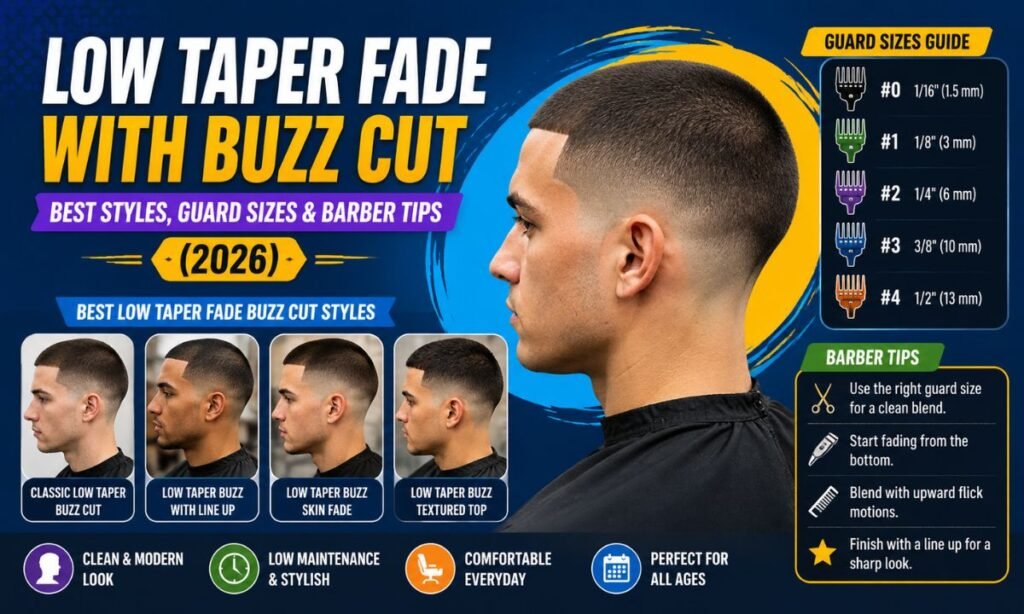
Low Taper Fade with Buzz Cut: Best Styles, Guard Sizes & Barber Tips (2026)
A Low Taper Fade with Buzz Cut is a clean and simple haircut that combines short hair with a smooth taper around the ears and neckline. It gives a sharp look while staying easy to maintain.
This style works well for different face shapes and hair types. Choosing the right guard size can help you get the perfect length and create a balanced, neat appearance.
In this guide, you will explore the best Low Taper Fade with Buzz Cut styles, useful guard sizes, and simple barber tips. These ideas can help you choose the right cut for your next visit.
What Is a Low Taper Fade with Buzz Cut?
A low taper fade with buzz cut combines two barbering techniques. The buzz cut clips the top to one short, uniform length. The low taper then fades the sides and back gradually, starting low, right above the ears and along the neckline, instead of climbing up toward the crown.
Because the fade starts low, the transition between the top and the sides stays subtle. There’s no dramatic contrast like you’d see with a high or mid fade. It reads clean up close and even cleaner from a distance, which is exactly why so many first-time buzz cut clients start here instead of going bolder.
Key traits of this cut:
- Top hair stays short and uniform, usually a #2 to #4 guard
- Fade begins low, around or just above the ear
- Blend can end at skin or stay just above bare scalp
- Low maintenance, minimal styling required
- Works with straight, thick, curly, and fine hair
Why This Haircut Is So Popular
The low taper fade with buzz cut keeps showing up as one of the most requested cuts in barbershops, and it’s not hard to see why once you break down what it actually offers.
- It’s low maintenance. No comb, no gel, no morning routine. You wake up and it already looks done.
- It grows out well. Because the fade sits low, regrowth doesn’t look messy as fast as a high fade does.
- It’s office-appropriate. Clean, short, and professional without looking severe.
- It suits almost every face shape. The subtle blend doesn’t add width or draw attention to any one feature.
- It’s beginner-friendly. For guys nervous about their first buzz cut, the low taper is the least intimidating way to try it.
- It works across hair types. Straight, curly, thick, or fine, the structure holds up.
ALSO READ THIS:Fade Maintenance Routine (Week-by-Week): Keep Your Fade Fresh Longer
Best Buzz Cut Guard Sizes for a Low Taper
Clipper guard numbers tell your barber exactly how much hair to leave on top. Lower numbers mean shorter hair; higher numbers leave more length and texture. Here’s how the most common guard sizes translate for a low taper buzz cut.
| Guard Size | Length Left | Best For |
| #1 Guard | ~1/8 inch | Bold, military-style look, lowest upkeep |
| #2 Guard | ~1/4 inch | Classic buzz cut feel with slight texture |
| #3 Guard | ~3/8 inch | Most popular default, balances length and structure |
| #4 Guard | ~1/2 inch | More styling options, most forgiving for first-timers |
#1 Guard Buzz Cut
The #1 guard leaves about 1/8 inch of hair, close to a shaved look. It’s the boldest option on this list and needs almost no upkeep beyond tracking regrowth. Good choice if you want a true military-style buzz with minimal styling and don’t mind the sides and top looking nearly the same length.
#2 Guard Buzz Cut
A step up from the #1, the #2 guard leaves roughly 1/4 inch. It’s still short but shows a bit more natural texture on top, especially on thicker hair. This is one of the safest, most requested lengths because it looks deliberate without feeling extreme.
#3 Guard Buzz Cut
The #3 guard sits around 3/8 inch and is the most common default for a low taper. It gives the top enough presence to contrast nicely against the faded sides, and it’s forgiving if your head shape or hairline isn’t perfectly even.
#4 Guard Buzz Cut
At half an inch, the #4 guard offers the most length in this range. It’s the most beginner-friendly option since it leaves room to go shorter next time. It also opens up more styling flexibility, like adding light texture with a small amount of matte clay.
Barber tip: If this is your first time trying a buzz cut, start with a #3 or #4. You can always go shorter at your next appointment, but you can’t add length back once it’s cut.
Best Low Taper Fade with Buzz Cut Styles
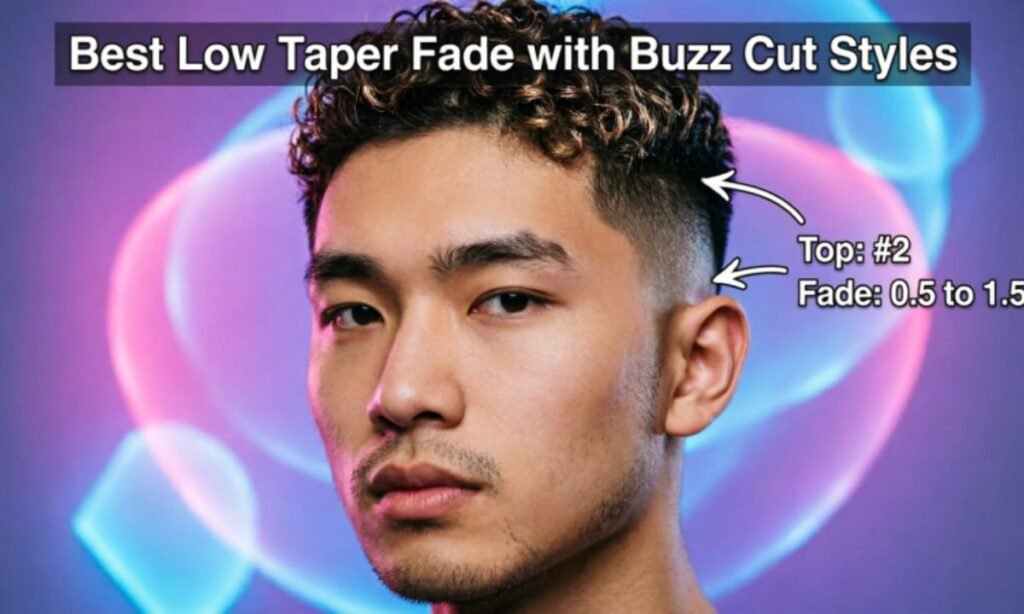
Not every low taper buzz cut looks the same. Here are the variations barbers get asked for most.
Classic Low Taper Buzz Cut

The no-frills version. Even length on top with a clean, low blend on the sides. No line-up, no design, just a sharp, simple cut that works in any setting, from the office to the gym.
Buzz Cut with Line Up
Adding a crisp line-up along the hairline and temples gives the cut a fresh, “just left the barbershop” finish. This is what separates a basic buzz from one that looks intentionally styled.
Low Taper Buzz Cut with Beard
A beard-connected low taper blends the fade straight into a faded beard line along the jaw, so the hair and beard read as one cohesive look. It’s a strong choice for guys who already keep facial hair groomed.
Skin Fade Low Taper Buzz
Instead of leaving a sliver of hair at the perimeter like a standard taper, the skin fade version cuts all the way down to bare scalp with no guard at all near the hairline. It creates a sharper, more defined edge while still keeping the fade low.
Curly Buzz Cut with Low Taper
For curly or coily hair, the top is usually kept a bit longer, around a #3 or #4, to preserve curl definition, while the sides are tapered clipper-over-comb so the pattern isn’t scalped flat.
Long Buzz Cut with Low Taper
Using a #4 or slightly longer clipper setting on top, this version gives more length to work with while the sides still taper down low. It’s a good middle ground for guys not ready to go super short.
Athletic Buzz Cut
Built for guys who sweat daily, whether from sports or workouts. Short length top to bottom, low taper on the sides, and zero need for styling products. Wash, dry, done.
Which Face Shapes Suit This Haircut?
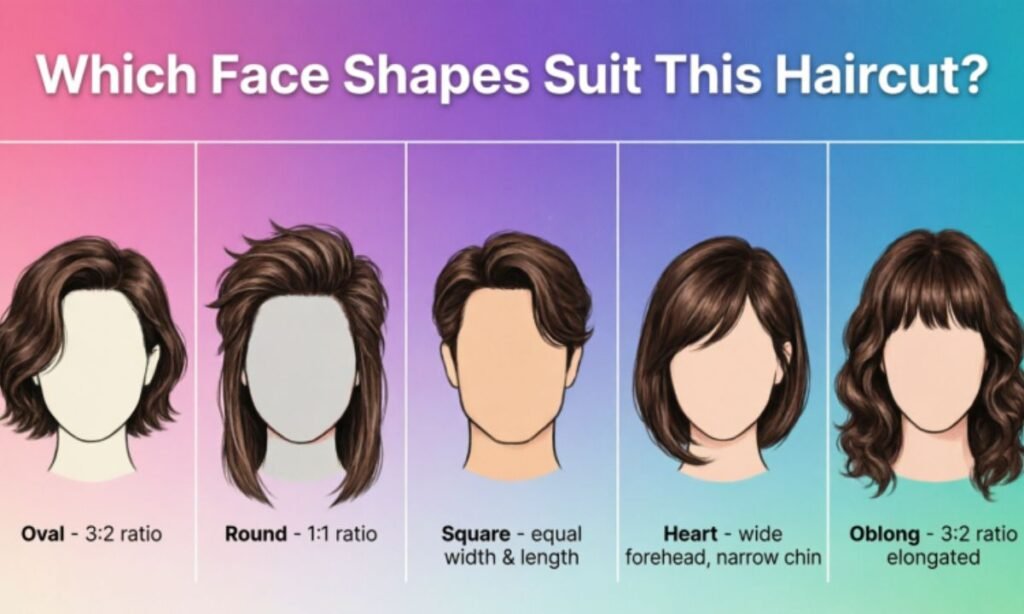
The low taper fade with buzz cut is flexible, but small adjustments make it work better for specific face shapes.
Round Face
A slightly longer top (#3 or #4) adds height and helps elongate the face. Avoid going too short all over, since a very tight buzz can emphasize roundness.
Oval Face
Oval faces can wear almost any guard size and fade height with this cut. It’s considered the most balanced face shape for a low taper buzz, since there’s little risk of the cut adding unwanted width.
Square Face
A low taper softens the strong jawline without hiding it. Pairing it with slightly rounded edges at the temples, instead of sharp lines, keeps the overall look balanced rather than boxy.
Long Face
Keeping some length on top (#3 or #4) and avoiding an overly high fade helps prevent the face from looking stretched. The low taper’s subtle blend works in your favor here since it doesn’t add extra vertical lines.
Best Hair Types for This Cut
| Hair Type | Recommended Guard | Notes |
| Straight | #2 to #3 | Lays flat, clean finish, minimal effort |
| Thick | #3 to #4 | Prevents scalp show-through, holds shape well |
| Curly | #3 to #4 | Preserves curl pattern, avoid clipper-only cutting |
| Fine | #2 to #3 | Shorter lengths hide thinning better |
Straight Hair
Straight hair lays flat and sleek at short lengths, giving a smooth, clean surface with almost no styling needed beyond a quick brush-through after washing.
Thick Hair
Thick hair holds shape well at a #3 or #4 and helps avoid the scalp becoming too visible, which can happen with very low guard numbers on dense hair.
Curly Hair
Curly hair shrinks once cut and dried, so it often looks shorter than the guard number suggests. Barbers typically go one size longer than they would for straight hair to hit the same visual length, and use clipper-over-comb technique to protect the curl pattern.
Fine Hair
Fine or thinning hair benefits from a uniform short length. A #2 or #3 guard minimizes the contrast between denser and thinner areas, making overall density look more even.
Low Taper Buzz Cut vs Regular Buzz Cut
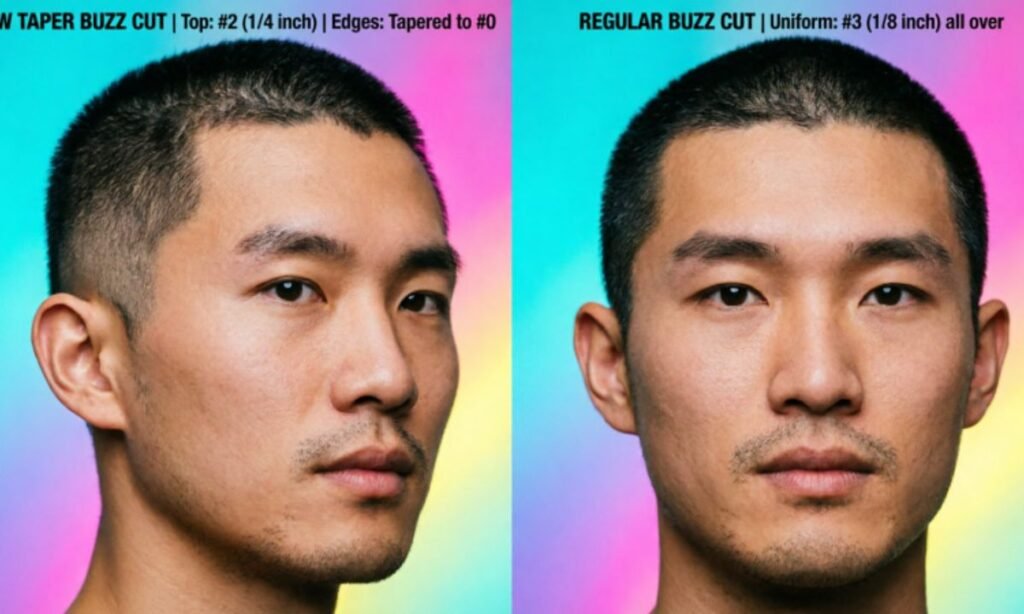
| Feature | Low Taper Buzz Cut | Regular Buzz Cut |
| Fade placement | Starts low, near ears/neckline | No fade, uniform length all over |
| Visual contrast | Subtle blend | None, flat length throughout |
| Maintenance frequency | Every 3–4 weeks | Every 2–3 weeks |
| Styling needed | Minimal to none | None |
| Best for | Guys who want a defined finish | Guys who want the simplest possible cut |
| Face shape flexibility | Higher, due to soft blend | Lower, since there’s no shaping around the sides |
The core difference comes down to detail. A regular buzz cut is the same length everywhere with no fade at all. A low taper buzz cut adds a graduated blend at the sides, giving it a more finished, deliberate look while keeping the same low-effort upkeep.
How to Ask Your Barber for a Low Taper Buzz Cut
Getting the exact look you want starts with clear communication. Use this checklist in the chair:
- Name the guard size for the top. Say “#3 guard on top” instead of “short.”
- Specify the fade placement. Say “low taper, starting right above the ear” so it doesn’t creep up higher than you want.
- Clarify the blend style. Ask for a smooth blend with no harsh lines, unless you specifically want a sharp edge-up.
- Mention extras upfront. Say if you want a line-up, beard connection, or skin fade at the perimeter.
- Bring a reference photo. Barbers are visual. A picture removes ambiguity, especially useful if guard numbers alone don’t fully capture the look you want.
- Confirm before cutting starts. Repeat back the guard size and fade height so there’s no mismatch once the clippers are on.
Common Mistakes to Avoid
Going Too Short the First Time
Jumping straight to a #1 guard on your first buzz cut is risky. Hair doesn’t grow back overnight, and a length that’s too short can expose scalp unevenness or uneven density you weren’t expecting. Start at a #3 or #4 and go shorter next time if you want more.
Taking the Fade Too High
A low taper is meant to stay low, near the ears and neckline. If a barber takes it up toward the temples or crown, it stops being a low taper and starts looking like a mid or high fade, which changes the entire shape of the cut and how it frames your face.
Ignoring Scalp Care
Short hair means the scalp is far more exposed to sun, dryness, and irritation. Skipping SPF or moisturizer on the scalp can lead to sunburn, flaking, or ingrown hairs, especially in the first few days after a fresh cut.
Maintenance Tips
- Get touch-ups every 3–4 weeks. Low tapers grow out slower-looking than high fades, but the blend still softens over time.
- Use a light moisturizer on the scalp. Prevents dryness and flaking on exposed skin.
- Apply SPF if you’re outdoors often. Short hair offers little natural sun protection.
- Keep the hairline and neckline cleaned up between full cuts. A quick trim at home or a barbershop neck shave keeps the cut looking fresh longer.
- Communicate changes early. If you want to grow it out or go shorter, tell your barber at the start of the appointment, not halfway through.
Frequently Asked Questions
Is a low taper fade with buzz cut good for beginners?
Yes. It’s one of the most beginner-friendly short haircuts since it requires no daily styling and is forgiving if you start with a longer guard.
How often do I need a touch-up?
Every 3 to 4 weeks. Low tapers grow out slower-looking than high fades, so they hold their shape longer.
What guard size is best for a low taper buzz cut?
A #3 guard is the most common default, though #2 works for thicker hair and #4 suits first-timers or thinner hair.
Can curly hair get a low taper fade with buzz cut?
Yes. Barbers typically leave the top slightly longer (#3 or #4) to account for curl shrinkage after drying.
Is this haircut professional enough for the office?
Yes. A clean, low taper buzz cut with a soft blend is considered one of the most work-appropriate short hairstyles available.
What’s the difference between a taper and a skin fade?
A taper leaves a small amount of visible hair at the perimeter. A skin fade cuts all the way down to bare scalp with no guard at all.
Does this cut work with a beard?
Yes. Many guys connect the low taper fade directly into a faded beard line along the jaw for a cohesive, groomed look.
Final Thoughts
The low taper fade with buzz cut earns its popularity by doing the basics extremely well: short, clean, low effort, and flattering across most face shapes and hair types. Whether you’re getting your first buzz cut or switching things up from a higher fade, picking the right guard size and communicating clearly with your barber is really all it takes to get this one right.