

A taper fade haircut is one of the most versatile men’s hairstyles because it can look clean and professional without removing too much hair from the sides. The basic idea is simple: the hair gradually becomes shorter around the temples, sideburns, and neckline while the top and much of the side hair retain more length.
Unlike a full fade that can remove most of the hair along the sides, a taper fade usually keeps more natural weight. That makes it easier to pair with almost any hairstyle on top, including a textured crop, curly top, slick back, quiff, pompadour, messy fringe, or classic side part.
In 2026, the biggest advantage of the taper fade is its flexibility. You can choose a low taper fade for a subtle appearance, a mid taper fade for balanced contrast, a high taper fade for a more noticeable finish, or a skin/bald taper fade when you want the shortest possible finish.
The important thing is understanding exactly what you are asking your barber to create. Terms such as low, mid, high, skin, and shadow describe different parts of the haircut. They should not be treated as interchangeable.
This guide explains everything you need to know before getting one—from the difference between a taper and a fade to choosing the right version for your face shape, hair type, lifestyle, and workplace.
What Is a Taper Fade?
A taper fade is a haircut in which the hair gradually decreases in length around selected areas of the head, usually the temples, sideburns, and neckline.
The transition is blended rather than cut as a single hard step. The result is a clean edge that gradually disappears into shorter hair or the skin.
The top is normally left significantly longer than the tapered areas. This gives you plenty of freedom when choosing the hairstyle on top.
A simple taper fade can therefore be thought of as three main areas:
| Area | Typical treatment |
|---|---|
| Top | Kept longer for styling |
| Temples and sideburns | Gradually shortened |
| Neckline | Gradually shortened and blended |
The exact height and finish can vary. A barber may create a low taper close to the ears and neckline, a mid taper higher around the temples, or a high taper that creates more visible contrast.
The word fade refers to the smooth transition between lengths. The shorter the transition becomes, the more noticeable and clean-cut the result can appear.
One important point is that barber terminology can vary from shop to shop. Some barbers use “taper fade” broadly, while others distinguish very carefully between a taper, taper fade, skin fade, and other fade styles.
ALSO READ THIS:Low Taper Fade with Buzz Cut: Best Styles, Guard Sizes & Barber Tips (2026)
What Is a Taper Fade Haircut?
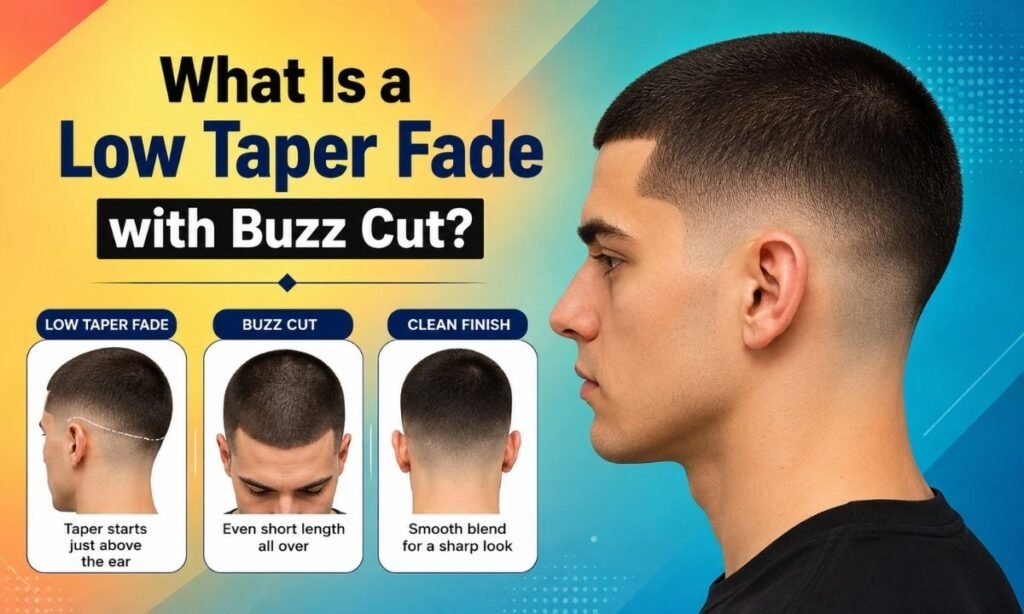
A taper fade haircut combines the gradual reduction of a taper with the blended finish of a fade.
Instead of cutting the sides to one uniform length, the barber creates a transition from longer hair into progressively shorter hair. The shortest section is concentrated around the hairline, temples, sideburns, or neckline depending on the style.
The major reason men choose this haircut is balance.
You get:
- A clean appearance around the edges
- More hair left on the sides than with many full fades
- Plenty of styling options on top
- A natural-looking grow-out
- A professional appearance when kept moderate
- The ability to customize the haircut around your face and hair texture
A taper fade can also be combined with almost any top hairstyle. For example, you could have a low taper with curls, a mid taper with a textured crop, or a high taper with a longer quiff.
Taper vs. Taper Fade
A regular taper generally reduces the hair toward the natural hairline but does not necessarily fade completely into the skin.
A taper fade takes that transition further. The hair becomes extremely short at the selected areas, sometimes reaching the skin depending on the requested finish.
This distinction is important when talking to your barber.
If you want visible hair remaining at the shortest point, say so. If you want the area to reach skin, specifically ask for a skin or bald taper fade.
Taper Fade vs Fade vs Low Fade
Although the terms are often used together, they describe different approaches to reducing hair length.
| Haircut | Main characteristic | Overall appearance |
|---|---|---|
| Taper fade | Focuses on temples, sideburns, and neckline | Clean and relatively subtle |
| Full fade | Fade covers more of the sides and back | Stronger contrast |
| Low fade | Fade begins low near the ears | Subtle but sharper |
| Mid fade | Fade begins around the temple area | Balanced contrast |
| High fade | Fade starts higher on the sides | Bold and noticeable |
| Skin fade | Shortest section reaches skin | Very sharp and high contrast |
The main difference is where the fade occurs and how much hair is removed.
Fade (Skin Fade):
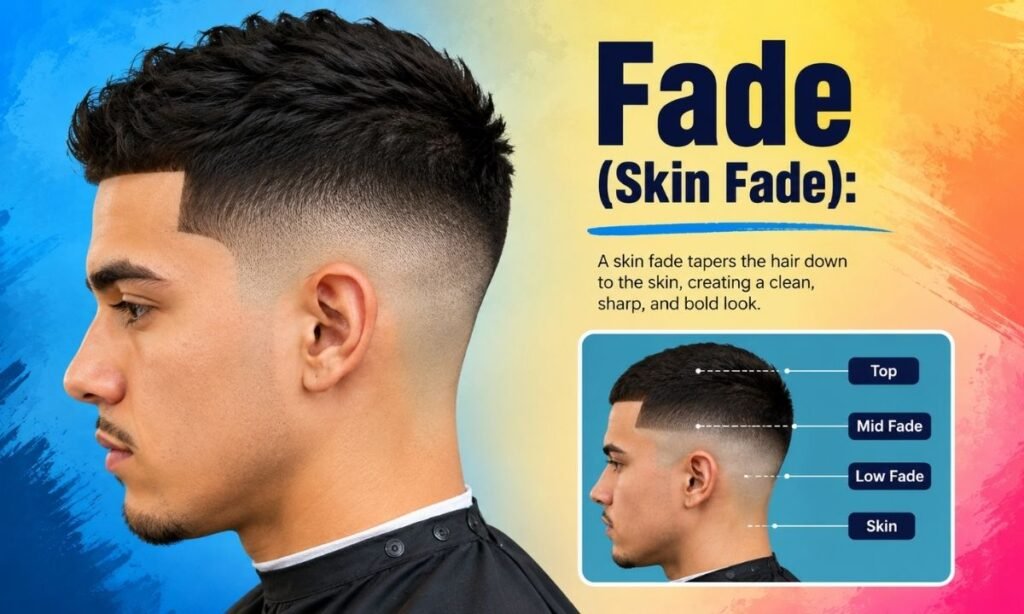
A traditional skin fade takes the sides and back down very close to the skin before blending upward into longer hair.
The result is usually more dramatic than a conventional taper fade.
A skin fade can work particularly well when you want strong contrast between the top and sides. It can also make a textured or curly top stand out.
However, because the shortest section is so close to the skin, regrowth can become noticeable relatively quickly.
Low Fade:
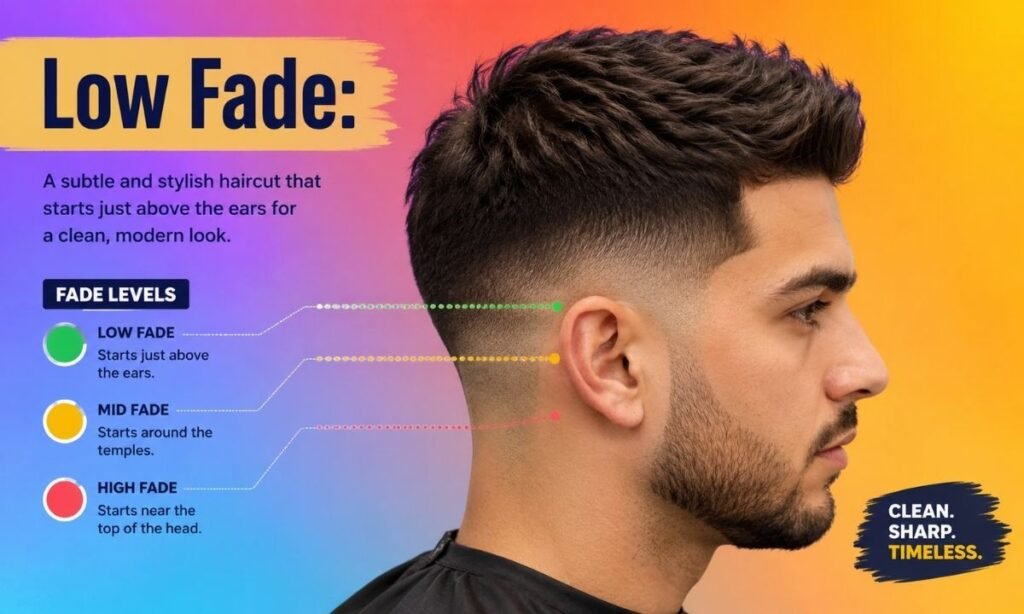
A low fade begins closer to the ear and lower side of the head.
It is one of the easiest fade styles to wear if you want a clean haircut without making the sides look extremely short.
A low fade is particularly useful for conservative workplaces, schools, and people trying a fade for the first time.
It also leaves more visual weight around the upper sides than a high fade.
Types of Taper Fade Haircuts
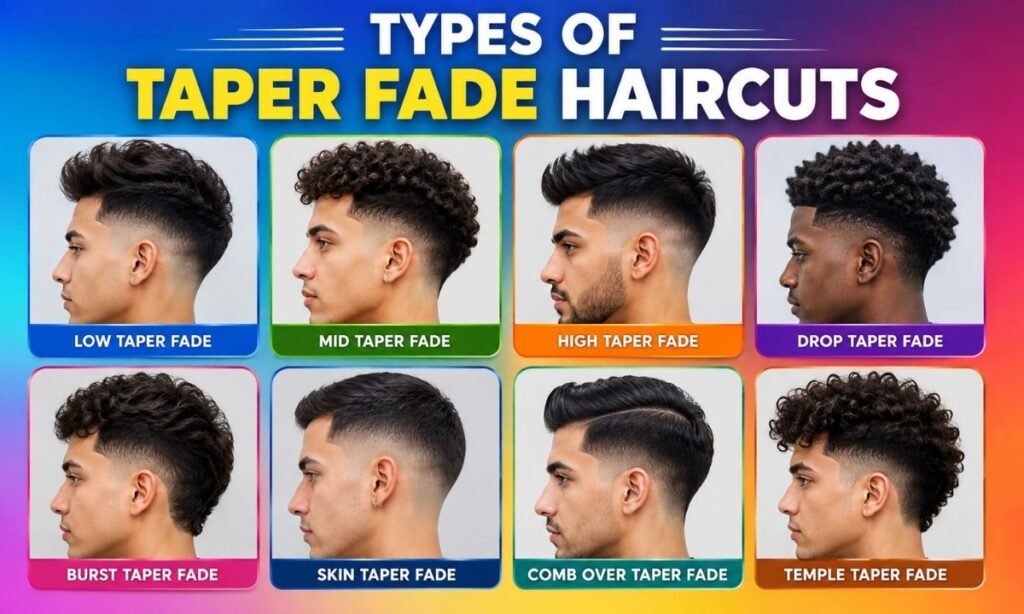
There are several ways to customize a taper fade. The most important distinction is the height of the taper.
The three basic placement choices are:
- Low taper fade
- Mid taper fade
- High taper fade
The shortest finish is a separate decision. You can have a low, mid, or high taper with a shadow, very short, or skin finish depending on what you and your barber agree on. Current barber guides increasingly emphasize separating placement from shortest endpoint because the words “low,” “mid,” and “high” describe where the blend sits rather than automatically determining how short it becomes.
Low Taper Fade
The low taper fade keeps the transition close to the ears, sideburns, and lower neckline.
It is the most conservative of the three main taper heights.
A low taper is ideal when you want your haircut to look polished without creating a dramatic change to your overall silhouette.
Why choose a low taper?
- It keeps more hair on the sides.
- It looks natural as it grows.
- It works well with longer hairstyles.
- It is suitable for professional environments.
- It is easy to combine with curly, wavy, or straight hair.
- It is a good choice for first-time fade wearers.
The low taper also works well if you like the shape of your current haircut but want cleaner edges.
Mid Taper Fade
A mid taper fade places the blend higher than a low taper, usually around the temple area.
It creates a noticeable but balanced transition.
This is often the safest option for someone who wants a modern haircut without going as aggressive as a high fade.
A mid taper works with:
- Textured crops
- Short quiffs
- Curly tops
- Waves
- Side parts
- Messy hairstyles
- Short pompadours
Because the placement sits between subtle and dramatic, the mid taper is one of the most adaptable choices.
High Taper Fade
A high taper fade brings the shortest section higher toward the upper sides and temples.
The increased height creates more contrast between the longer hair and the tapered areas.
This makes the haircut look sharper and more contemporary.
A high taper is especially useful if you want the sides to look significantly cleaner and slimmer.
However, it can expose more of the shape of your head. For that reason, your barber should consider your head shape, hair density, hairline, and desired top length before taking the taper too high.
Skin / Bald Taper Fade
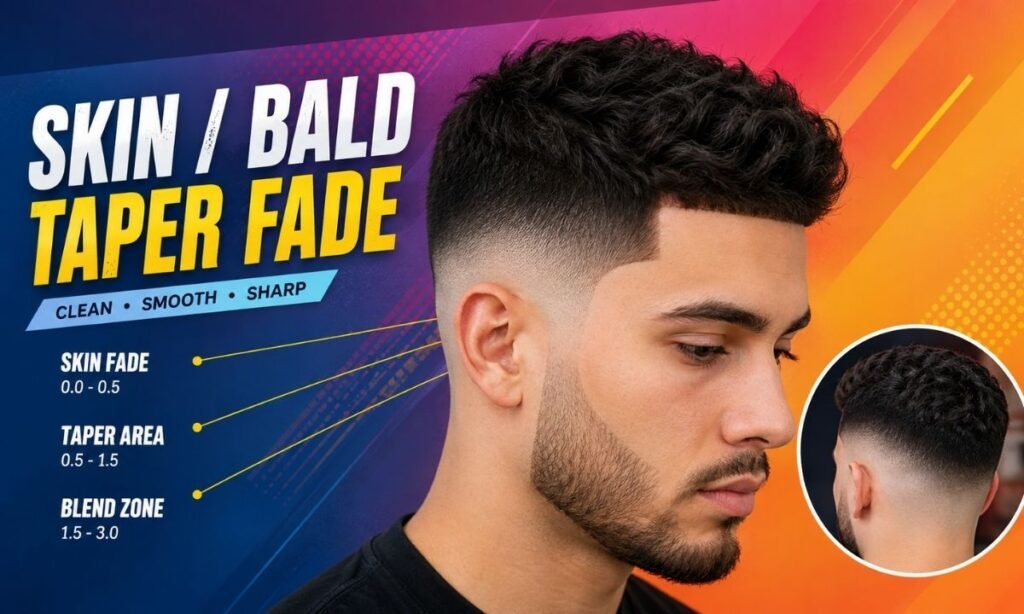
A skin taper fade, also called a bald taper in some barber shops, takes the shortest portion down to the skin.
It gives the cleanest possible finish around the selected areas.
The skin finish can be combined with low, mid, or high placement.
For example:
Low + skin: subtle placement with an extremely short finish.
Mid + skin: balanced placement with strong contrast.
High + skin: dramatic placement and strong contrast.
Because skin fades show regrowth quickly, they generally require more frequent touch-ups if you want the freshly cut appearance to remain sharp.
Best Taper Fade for Face Shapes
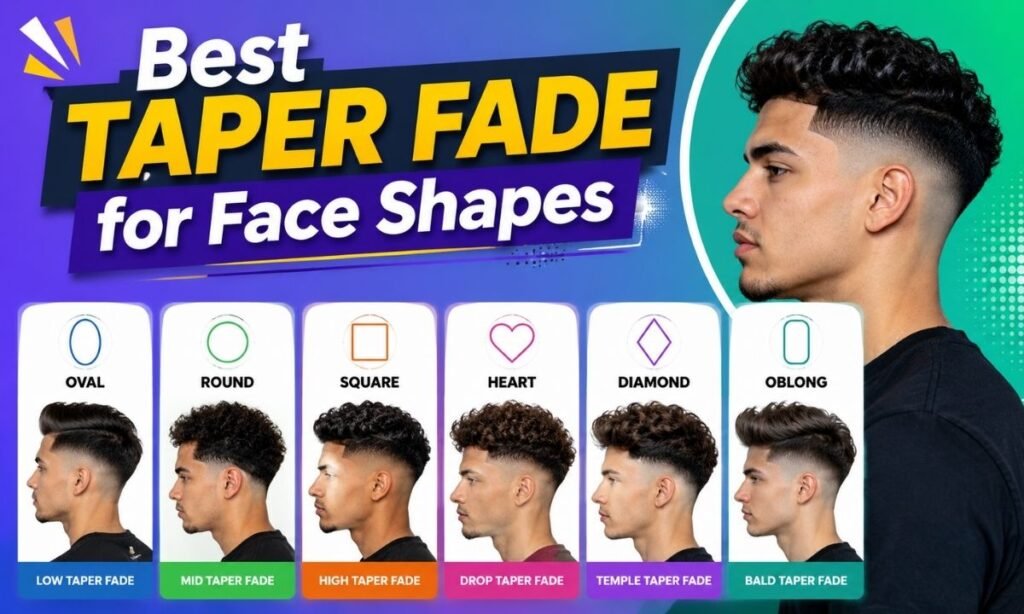
There is no single taper fade that is universally best for every face shape. The goal is to create visual balance.
Your barber should consider:
- Face width
- Face length
- Jawline
- Forehead
- Cheekbone width
- Head shape
- Hair volume
- Desired top length
Here is a practical starting point.
| Face shape | Good taper choice | Styling idea |
|---|---|---|
| Oval | Almost any taper | Experiment with top styles |
| Round | Mid or high taper | Add height and texture |
| Square | Low or mid taper | Keep natural structure |
| Oblong | Low taper | Avoid excessive height |
| Heart | Low or mid taper | Maintain balanced side volume |
| Diamond | Low or mid taper | Add controlled width |
| Triangle | Low or mid taper | Avoid making sides too narrow |
Oval Face
An oval face is relatively balanced, so most taper heights can work.
You have more freedom to experiment with a low, mid, or high taper.
The top can also vary from short and textured to longer and swept back.
Round Face
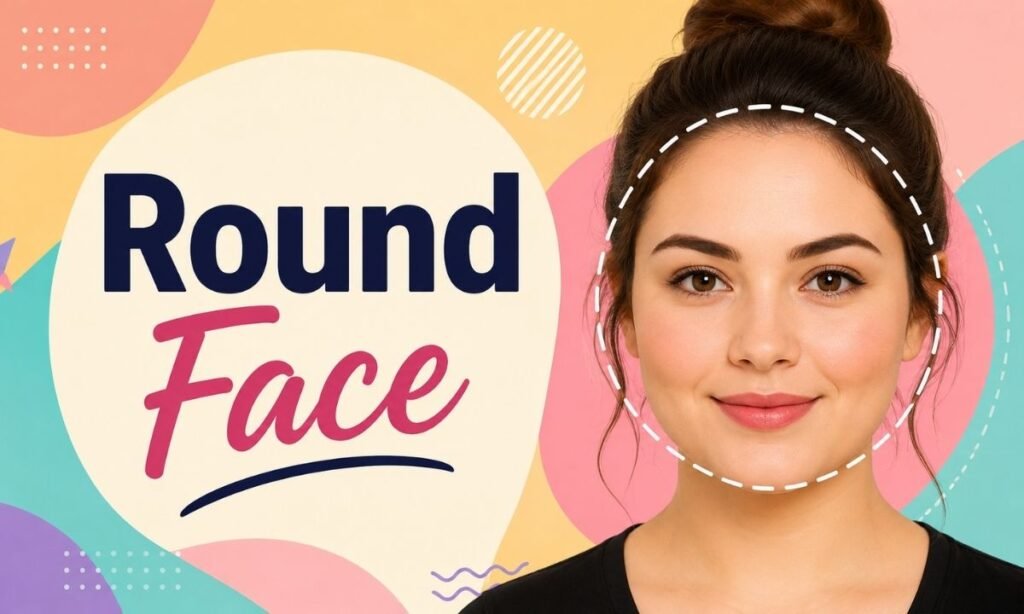
If your face is round, adding some height on top can make the face appear longer.
A mid or high taper can help create a cleaner vertical shape, particularly when paired with textured volume.
Avoid creating excessive width at the sides if your goal is to make the face look more elongated.
Square Face
A square face already has a strong jawline and defined proportions.
A low or mid taper can preserve that natural structure without making the haircut overly aggressive.
A textured crop, side part, or short quiff can work particularly well.
Oblong Face
An oblong face is longer than it is wide.
In this case, a very high taper combined with significant height on top can make the face appear even longer.
A low taper with moderate top volume is often a better starting point.
Heart-Shaped Face
A heart-shaped face is generally wider around the forehead and narrower toward the chin.
A low or mid taper can help maintain visual balance.
Avoid removing too much width too high on the sides unless that is specifically the look you want.
Diamond Face
Diamond faces are typically narrower around the forehead and jaw with more width around the cheekbones.
A low or mid taper can preserve some side volume while still creating clean edges.
Texture and controlled volume on top can complement the natural shape.
Triangle Face
A triangle-shaped face is usually wider around the jaw and narrower around the forehead.
A low or mid taper may work better than an extremely high taper because it does not aggressively reduce the sides.
The top can then be styled with moderate volume.
Best Taper Fade for Hair Types
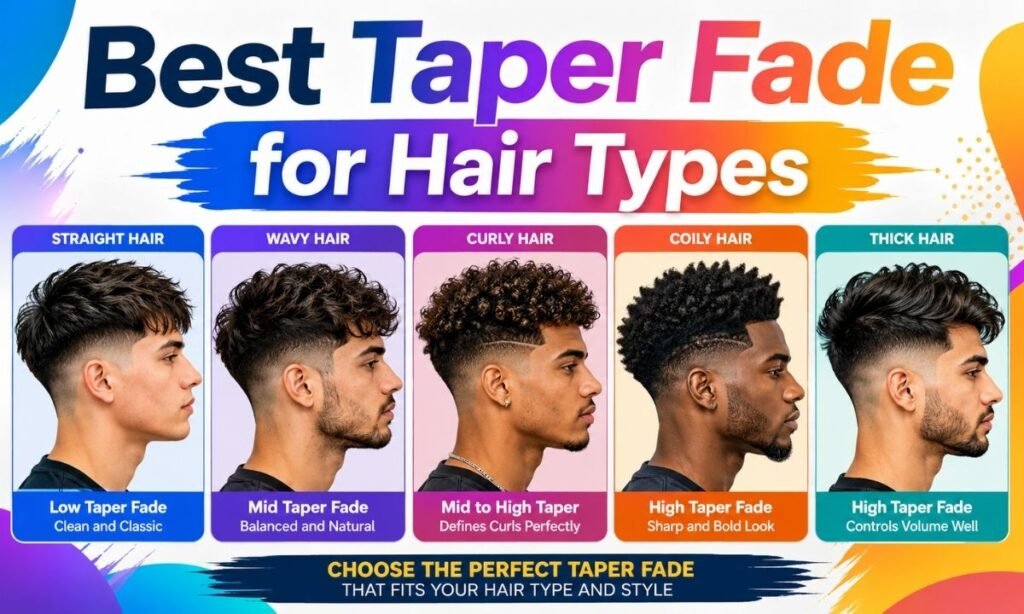
One of the biggest advantages of the taper fade is its adaptability.
It can work with:
- Straight hair
- Wavy hair
- Curly hair
- Coily hair
- Thick hair
- Fine hair
- Dense hair
- Receding hairlines
- Textured hair
The technique, however, should change according to the hair.
Straight Hair
Straight hair shows the transition between lengths very clearly.
That makes blending especially important.
A low taper works well for a classic look, while a mid or high taper can create stronger contrast.
Straight hair can be styled into a:
- Side part
- Quiff
- Slick back
- Textured crop
- Fringe
- Pompadour
Wavy Hair
Wavy hair naturally adds texture to the top.
A low or mid taper can clean up the sides while allowing the waves to remain the focus.
A matte styling cream or light texture product can enhance the natural movement without making the hair look stiff.
Curly Hair
Curly hair pairs extremely well with taper fades.
The shorter sides make the curls on top more prominent.
A barber should work with your curl pattern rather than forcing the hair into a shape it does not naturally support.
Popular combinations include:
- Low taper + curls
- Mid taper + curly top
- Temple taper + curls
- Skin taper + defined curls
Coily Hair
A taper can provide a clean outline while preserving natural texture and volume.
The barber needs to understand how tightly the hair curls because shrinkage can make the finished top appear shorter than expected.
Communication about the desired final length is therefore important.
Thick Hair
Thick hair provides plenty of styling possibilities.
A taper can remove unnecessary bulk around the edges while leaving enough density on top for texture and volume.
If your hair is extremely thick, tell your barber whether you want the top debulked or whether you want to keep its natural fullness.
Fine Hair
A taper can make fine hair look cleaner by giving the haircut a defined outline.
However, taking the sides too short can sometimes make the difference in density between the top and sides more noticeable.
A low taper is often a useful starting point if you want a softer transition.
Popular Taper Fade Styles
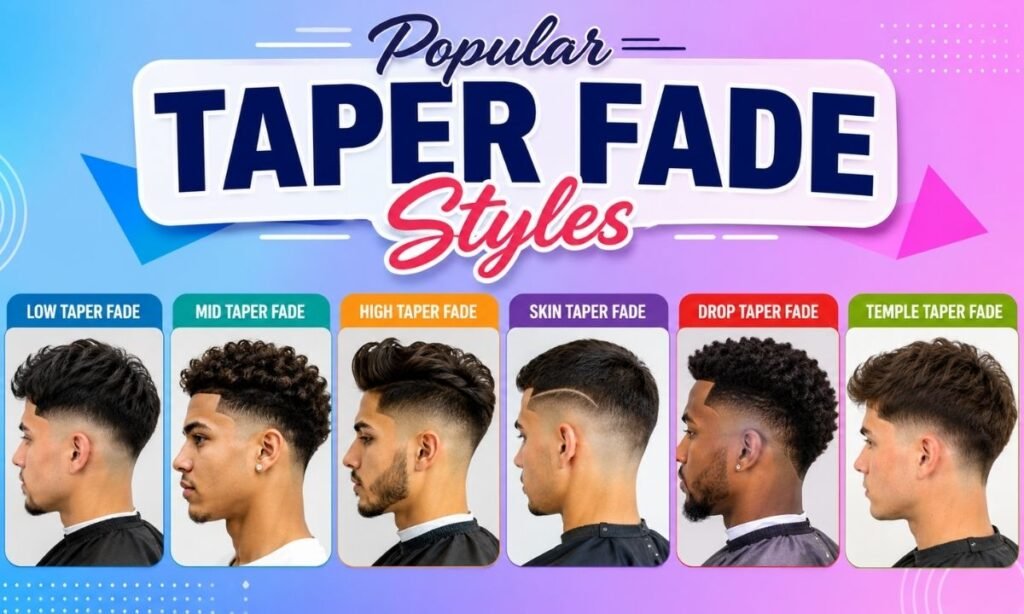
The taper fade does not have to be worn as a standalone haircut. It can be combined with many popular men’s hairstyles.
Taper Fade With Textured Crop
A textured crop keeps the top relatively short while adding movement.
The taper provides clean edges without taking attention away from the texture.
This is a practical low-styling option.
Taper Fade With Quiff
A quiff adds height at the front.
Pairing it with a taper creates contrast between the structured top and clean sides.
This works particularly well for straight and wavy hair.
Taper Fade With Pompadour
The pompadour requires more volume and styling.
A taper gives the sides a neat appearance while allowing the top to remain prominent.
It is a stronger choice for people who enjoy spending time styling their hair.
Taper Fade With Side Part
The side part is one of the most office-friendly combinations.
A low taper creates a conservative appearance, while a mid taper makes the haircut more contemporary.
Taper Fade With Curly Top
Curly hair looks particularly strong when the sides are tapered.
The haircut emphasizes the curls without requiring the entire head to be faded.
Taper Fade With Fringe
A fringe can make the haircut look more youthful and textured.
A low taper is generally the softer choice, while a higher taper creates greater contrast.
Taper Fade With Slick Back
The slick back requires enough top length to move the hair backward.
A taper keeps the sides controlled while maintaining the longer top needed for styling.
Taper Fade With Buzz Cut
A short buzzed top combined with a taper creates an extremely low-maintenance haircut.
The taper adds shape and definition around the edges.
Taper Fade With Beard
A taper can transition into facial hair around the sideburns.
If you have a beard, tell your barber whether you want the sideburn area blended naturally into the beard or clearly separated.
A well-planned transition can make the haircut and beard look like one connected style.
How to Ask Your Barber for a Taper Fade
Simply saying “I want a taper fade” may not give your barber enough information.
The phrase describes the general haircut, but several details remain undecided.
The best barber request covers five things:
- Taper height
- Shortest finish
- Amount of side length
- Top length and style
- Neckline and sideburn preference
For example, you could say:
“I want a low taper around the temples and neckline. Keep plenty of length on the sides and leave about three inches on top. I want the shortest part blended but not taken completely to skin.”
Or:
“Give me a mid taper with a skin finish around the sideburns and neckline. Keep the top long enough for a textured quiff.”
The exact guard numbers are less important than clearly explaining the desired result.
Bring a Reference Photo
A reference photo is one of the easiest ways to avoid a misunderstanding.
Ideally, bring:
- A front view
- A side view
- A back view
Pictures show your barber the actual placement, length, shape, and finish you want.
Professional hair advice also commonly recommends using photographs rather than relying entirely on barber terminology because terms such as “fade” can mean different things to different clients and shops.
Ask These Questions
Before the haircut starts, ask:
- How high will the taper sit?
- Will the shortest part reach skin?
- How much weight will remain on the sides?
- How much length should I keep on top?
- How will you handle my neckline?
- How will the taper connect to my beard?
- How often will I need a touch-up?
These questions can prevent most unwanted surprises.
How Long Does a Taper Fade Last?
A taper fade usually looks sharp for approximately 2 to 4 weeks, depending on how short the finish is and how quickly your hair grows.
A subtle taper may remain presentable for longer because it leaves more hair around the edges.
A skin taper can show regrowth much sooner.
| Taper style | Typical touch-up period |
|---|---|
| Low taper | About 3–5 weeks |
| Mid taper | About 2–4 weeks |
| High taper | About 2–3 weeks |
| Skin/bald taper | About 1–3 weeks |
These are practical estimates rather than fixed rules. Hair growth varies considerably from person to person, and some barbers recommend touch-ups every few weeks to preserve a sharp outline.
If you do not mind a softer grow-out, you can wait longer.
If you want the haircut to look freshly cut at all times, schedule more frequent appointments.
Taper Fade Maintenance Tips
A taper fade does not require complicated maintenance, but regular grooming makes a major difference.
1. Keep a Consistent Barber Schedule
If you like a crisp finish, do not wait until the neckline becomes completely overgrown.
A quick cleanup can often restore the appearance without requiring a full haircut.
2. Wash According to Your Hair Type
Your washing routine should depend on your scalp and hair texture.
Overwashing can make some hair types dry, while insufficient cleansing can leave buildup.
Use products appropriate for your hair rather than choosing shampoo solely because it is marketed for men.
3. Condition Longer Hair
The tapered sections need little styling, but the longer top may benefit from conditioner.
This is especially useful for curly, wavy, coarse, or dry hair.
4. Avoid Excessive Product
A taper fade already creates structure.
You usually do not need large amounts of pomade, wax, clay, or gel.
Start with a small amount and add more only if necessary.
5. Keep the Neckline Clean
The neckline is one of the first areas where regrowth becomes visible.
Ask your barber whether a simple neckline cleanup between full appointments makes sense.
6. Protect Your Hair From Excessive Heat
If you use a blow dryer regularly, avoid excessive heat.
Use an appropriate heat-protective product when necessary and do not hold the dryer in one place for too long.
7. Work With Your Natural Texture
Do not fight your natural curl, wave, or movement unnecessarily.
A good taper should make your natural hair easier to manage rather than forcing it into an unsuitable shape.
Is a Taper Fade Good for Office or School?
Yes. A low taper fade is particularly suitable for offices and schools because it can look clean without being excessively dramatic.
A conservative taper generally keeps more hair on the sides and creates a softer transition.
For a professional environment, consider:
- Low taper
- Moderate top length
- Natural neckline
- Minimal hard lines
- Controlled styling
- Clean sideburns
A mid taper can also work in many workplaces if the dress code is relaxed.
A high or skin taper may be less suitable for conservative environments because it creates stronger contrast and a more noticeable haircut.
The best choice ultimately depends on your workplace or school’s grooming policy.
Common Taper Fade Mistakes to Avoid
Even a skilled barber cannot guarantee the result you want if the instructions are unclear.
Mistake 1: Saying Only “Give Me a Fade”
“Fade” does not tell the barber how high you want it, how short it should finish, or how much side weight you want.
Specify the height and finish.
Mistake 2: Not Showing a Photo
A photo gives your barber a visual target.
It is especially helpful when you are trying a new style.
Mistake 3: Choosing a High Taper Without Considering Head Shape
A high taper removes more hair from the sides.
If you are unsure, start lower. Your barber can always take the taper higher, but cut hair cannot immediately be put back.
Mistake 4: Ignoring the Top
The taper is only one part of the haircut.
Tell your barber exactly what you want to do with the top.
For example:
- Keep it long
- Add texture
- Leave curls intact
- Create a fringe
- Keep a side part
- Style it backward
Mistake 5: Using Guard Numbers Without Explaining the Look
Guard numbers are useful, but they do not describe the entire haircut.
The same guard can look different depending on hair density, texture, blending technique, and head shape.
Mistake 6: Taking the Taper Too High
If you want a conservative haircut, a high taper may remove more side weight than you expect.
Start with a low or mid taper if you are uncertain.
Mistake 7: Ignoring the Hairline
Your natural hairline affects how the taper looks.
A barber should work with your existing hairline rather than forcing an artificial shape that does not suit you.
Mistake 8: Expecting a Skin Fade to Stay Fresh for a Month
Very short fades reveal regrowth quickly.
If you choose a skin taper, expect to maintain it more frequently.
Mistake 9: Forgetting the Beard
If you have facial hair, the sideburn transition matters.
Tell the barber whether you want the taper connected to the beard or kept separate.
Mistake 10: Copying a Haircut Without Considering Your Hair
A haircut photograph shows someone else’s hair density, texture, head shape, and styling routine.
Use the photo as inspiration rather than expecting an identical result.
Taper Fade vs. Regular Taper
The difference is mainly the finish.
| Feature | Regular taper | Taper fade |
|---|---|---|
| Transition | Gradual | Gradual and more blended |
| Shortest area | Usually short | Can reach skin |
| Contrast | Lower | Usually higher |
| Appearance | Classic | Modern |
| Maintenance | Moderate | Depends on fade height |
A regular taper is a strong choice if you want a traditional, understated haircut.
A taper fade is better when you want a cleaner, more defined transition.
Taper Fade vs. Low Fade
These styles can look similar, but they are not necessarily the same.
A low fade generally describes a fade that starts low on the sides, while a taper fade usually concentrates the taper around the temples, sideburns, and neckline.
A low fade may remove more hair across the sides than a traditional taper.
If you want the sides to retain substantial weight, tell your barber that clearly.
Taper Fade vs. Mid Fade
A mid fade usually extends farther across the sides than a traditional taper.
The transition begins around the middle portion of the side of the head.
A mid taper can provide some of that visual structure while keeping more natural side weight.
Choose a mid taper if you want:
- More contrast than a low taper
- Less intensity than a high fade
- A modern but flexible haircut
- A style that works with many top lengths
Taper Fade vs. High Fade
A high fade removes more hair higher up the sides.
A high taper is usually more concentrated around specific areas, depending on how the barber interprets the request.
If you want the sides to remain relatively full, a high fade may be too aggressive.
If you want strong contrast and a sharper silhouette, a high fade can be appropriate.
Can You Get a Taper Fade With Long Hair?
Yes.
A taper fade does not require a short top.
In fact, keeping the top long can create an attractive contrast between the styled hair and clean edges.
Longer top combinations include:
- Long textured top
- Slick back
- Flow
- Quiff
- Curtains
- Messy layers
- Curly top
The longer the top, the more important it becomes to explain how much length you want to preserve.
Can You Get a Taper Fade With Curly Hair?
Yes. Curly hair is one of the most popular textures to combine with a taper.
The taper cleans up the temples and neckline while leaving the natural curls visible.
For tight curls or coils, your barber should account for shrinkage and density.
A low taper is a good starting point if you want a subtle change.
A skin taper creates more contrast if you want the curls to become the main visual focus.
Can You Get a Taper Fade With a Receding Hairline?
A taper can still work with a receding hairline, but the haircut should be customized.
A barber can often use texture and controlled top length to create a balanced appearance.
Avoid assuming that a higher fade automatically hides a receding hairline. In some cases, taking the sides too high can make the difference in hair density more obvious.
Talk to your barber about your natural hairline before deciding on the taper height.
How to Choose Between Low, Mid, and High Taper
If you are unsure which taper to choose, use this simple guide:
Choose a low taper if:
- You want a subtle haircut.
- You work in a conservative environment.
- You want to keep side volume.
- You are getting your first taper.
- You prefer an easy grow-out.
Choose a mid taper if:
- You want balanced contrast.
- You want a modern appearance.
- You like both short and medium-length hairstyles.
- You want more definition than a low taper.
Choose a high taper if:
- You want stronger contrast.
- You prefer a sharper appearance.
- You want the sides to look significantly cleaner.
- You are comfortable with more frequent maintenance.
Choose a skin taper if:
- You want the shortest possible finish.
- You like strong contrast.
- You do not mind frequent touch-ups.
Which Taper Fade Is Best for Beginners?
For someone getting their first taper fade, a low taper fade is usually the safest starting point.
It removes less side weight and is easier to adjust during future appointments.
You can always ask your barber to move the taper higher later.
Starting conservatively gives you more control over the final result.
Which Taper Fade Is Lowest Maintenance?
A low taper with a shadow or slightly longer finish is generally easier to maintain than a high skin taper.
The reason is simple: longer hair does not show regrowth as quickly.
If you want a haircut that still looks acceptable several weeks after the appointment, avoid taking the shortest section extremely high and extremely close to the skin.
Which Taper Fade Looks the Most Modern?
There is no single answer because modern men’s hairstyles change constantly.
However, combinations such as a textured top + low or mid taper, curly top + taper, and clean taper + natural texture remain highly adaptable.
Current 2026 hairstyle discussions are also placing strong emphasis on texture, movement, and less rigid styling rather than overly controlled finishes.
The best modern taper is therefore not necessarily the most dramatic one. It is the one that fits your hair, face, and styling habits.
How Much Does a Taper Fade Cost?
The price depends heavily on location, barber experience, shop type, and whether additional services are included.
A basic taper may cost less than a detailed haircut involving:
- Beard shaping
- Hot towel treatment
- Skin finish
- Hair design
- Scissor work
- Styling
- Line-up
Instead of choosing a barber solely by price, look at their previous taper work.
A clean blend requires technique, and the quality of the transition has a major effect on the final appearance.
Can You Maintain a Taper Fade at Home?
Basic maintenance at home is possible, but recreating a professional taper fade is much harder.
A proper fade requires control of:
- Clipper angles
- Guard lengths
- Blending
- Guidelines
- Weight removal
- Hairline shape
- Head shape
- Symmetry
If you only need a temporary cleanup, you may be able to tidy the neckline and sideburns.
For the actual fade, a professional barber is usually the safer choice.
What Products Work With a Taper Fade?
The taper itself does not determine which styling product you need.
Your top hairstyle and hair texture do.
Matte Clay
Good for textured, controlled styles where you want a low-shine finish.
Pomade
Useful for slick backs, side parts, and polished hairstyles.
Styling Cream
Good for softer control and natural-looking texture.
Curl Cream
Useful for defining curly or coily hair without making it excessively stiff.
Sea Salt Spray
Can add texture and movement to suitable hair types, especially when creating a messy or beach-inspired finish.
Start with a small amount of product. Too much can weigh the hair down and make the haircut look less natural.
Taper Fade Maintenance Schedule
A practical maintenance schedule depends on your preferred level of sharpness.
| Goal | Suggested approach |
|---|---|
| Always freshly cut | Touch-up every 1–2 weeks |
| Consistently sharp | Every 2–3 weeks |
| Normal maintenance | Every 3–4 weeks |
| Longer grow-out | Around 4–5 weeks or as needed |
There is no mandatory schedule.
If your haircut still looks good after four weeks, there is no reason to return earlier simply because a calendar says so.
Taper Fade for School
For school, a low taper is usually the safest option.
It looks clean while remaining relatively subtle.
If the school has specific grooming rules, check them before choosing a high or skin finish.
A low taper with a natural top is usually easier to keep within conservative grooming requirements.
Taper Fade for College
College gives you more freedom to experiment.
A mid taper can provide a modern look without becoming extremely dramatic.
You can also combine it with:
- Curly hair
- Fringe
- Textured crop
- Quiff
- Longer top
- Messy styling
Taper Fade for Work
For an office, choose your taper according to the company culture.
A conservative workplace usually favors:
- Low taper
- Natural finish
- Moderate top length
- Clean neckline
- Controlled styling
A creative workplace may allow a mid or high taper.
The haircut should match the environment in which you actually spend your time.
Taper Fade for Special Occasions
A taper fade is excellent for weddings, interviews, parties, and formal events because the clean edges make the haircut look intentional.
For a formal event, schedule the haircut roughly a few days before the occasion rather than immediately beforehand if you prefer the fade to look slightly more natural.
If you specifically want an ultra-crisp skin finish, getting it closer to the event may be preferable.
Taper Fade Styling Routine
A simple daily routine can be enough.
Step 1: Start With Clean or Appropriately Refreshed Hair
Your hair should not be overloaded with old styling product.
Step 2: Towel Dry
Remove excess water without aggressively rubbing the hair.
Step 3: Apply a Small Amount of Product
Choose a product based on your desired finish.
Step 4: Shape the Top
Use your fingers, comb, or brush depending on the hairstyle.
Step 5: Blow Dry if Necessary
Use controlled airflow to create additional volume or direction.
Step 6: Finish Lightly
Add a small amount of product only if additional control is needed.
The taper itself requires almost no daily styling. Most of your attention should go toward the longer hair on top.
What Should You Tell Your Barber About the Neckline?
The neckline can dramatically change the final appearance.
Common options include:
- Natural neckline
- Tapered neckline
- Blocked neckline
- Rounded neckline
For a taper fade, a tapered neckline is often a natural match because it continues the gradual transition.
If you are unsure, ask your barber which neckline works best with your hair growth pattern.
What Should You Tell Your Barber About the Sideburns?
Sideburn length and shape should match the haircut and facial hair.
You can request:
- Short tapered sideburns
- Natural sideburns
- Sideburns blended into the beard
- Clean separation from the beard
If you wear a beard, show your barber where you want the transition.
Is a Taper Fade Good for Thick Hair?
Yes.
Thick hair can benefit from a taper because it removes bulk around the edges while keeping the top full.
If the top becomes difficult to manage, ask your barber whether controlled debulking or texturizing would help.
Do not automatically ask for the sides to be shaved extremely short simply because your hair is thick.
Is a Taper Fade Good for Thin Hair?
It can be.
The key is maintaining the right balance.
A low taper can create a neat outline without making the difference between the top and sides overly obvious.
Your barber can also recommend a top style that creates the appearance of more texture and volume.
Is a Taper Fade Good for Straight Hair?
Yes.
Straight hair makes the taper’s blending especially visible, so precision matters.
A low taper works well for a classic look, while a mid or high taper creates more contrast.
Is a Taper Fade Good for Wavy Hair?
Yes.
Wavy hair provides natural texture, which can make the contrast between the tapered sides and longer top particularly attractive.
A low or mid taper is a strong starting point.
Is a Taper Fade Good for Curly Hair?
Absolutely.
The taper creates a clean frame around naturally curly hair.
You can keep the curls short, medium, or relatively long depending on the desired appearance.
The barber should cut according to your curl pattern and shrinkage.
Is a Taper Fade Good for Coily Hair?
Yes.
A taper can create a sharp outline while preserving the natural density and texture of coily hair.
The best result depends on maintaining the appropriate amount of length and shape on top.
Is a Taper Fade Good for Men With Beards?
Yes.
A taper can connect smoothly to a beard, especially around the sideburn area.
The important decision is whether you want the transition to be:
- Blended
- Defined
- Natural
- Very sharp
Tell your barber before the haircut begins.
How to Make a Taper Fade Look Better
The haircut itself is only part of the result.
A better overall appearance comes from matching the taper to your:
- Face shape
- Hair texture
- Hair density
- Lifestyle
- Workplace
- Beard
- Styling ability
- Maintenance schedule
A dramatic high skin taper may look excellent in a photograph but be inconvenient if you do not want frequent barber visits.
A subtle low taper may be less dramatic but much easier to maintain.
The best haircut is the one you can realistically keep looking good.
Quick Taper Fade Decision Guide
If you want a simple answer, use this:
For a subtle look: choose a low taper.
For a balanced modern look: choose a mid taper.
For a bold look: choose a high taper.
For maximum contrast: choose a skin/bald taper.
For office or school: choose a low taper with a natural finish.
For curly hair: choose a low or mid taper and preserve the curl pattern.
For thick hair: use the taper to reduce edge bulk while keeping top volume.
For low maintenance: choose a low taper with a slightly longer finish.
For a dramatic hairstyle: consider a higher taper with a short finish.
Taper Fade Checklist Before Your Haircut
Before sitting in the barber chair, decide:
- Low, mid, or high?
- Skin, shadow, or visible hair at the shortest point?
- How much side length should remain?
- How long should the top be?
- What hairstyle will you wear on top?
- What should happen to the sideburns?
- Should it connect to your beard?
- What neckline do you want?
- How often can you visit your barber?
- Does your school or workplace have grooming rules?
If you can answer those questions, your barber has a much better chance of delivering the result you expect.
Frequently Asked Questions About Taper Fade Haircuts
What is a taper fade?
A taper fade gradually reduces hair length around areas such as the temples, sideburns, and neckline while leaving more length on the top and sides.
Is a taper fade the same as a fade?
No. A taper fade usually focuses the transition around selected areas, while a full fade generally extends farther across the sides and back.
Which taper fade is best for beginners?
A low taper fade is usually the easiest starting point because it keeps more side length and creates a subtle change.
How long does a taper fade last?
Most taper fades look sharp for roughly 2–4 weeks, although growth speed and the desired level of sharpness vary.
How often should I get a taper fade?
For a consistently fresh appearance, many people schedule a touch-up every 2–4 weeks.
Is a taper fade good for curly hair?
Yes. A taper can clean up the edges while allowing the natural curls on top to remain the focus.
Is a taper fade good for straight hair?
Yes. Straight hair can show a clean blend particularly well, making precision important.
Which taper fade is best for a round face?
A mid or high taper paired with moderate height and texture on top can help create a more elongated appearance.
Which taper fade is best for an oval face?
An oval face is versatile, so low, mid, and high taper fades can all work depending on your preferred style.
Is a low taper fade professional?
Yes. A low taper is one of the most conservative and office-friendly versions of the haircut.
Is a skin taper high maintenance?
Yes. Skin finishes show regrowth faster, so they generally require more frequent touch-ups to remain extremely sharp.
Can you get a taper fade with long hair?
Yes. A taper can be combined with long, medium, or short hair on top.
Can a taper fade hide a receding hairline?
It can help create a balanced appearance, but it does not stop or reverse hair loss. The taper should be customized to your natural hairline.
Should I show my barber a picture?
Yes. A clear reference photo can communicate the desired height, shape, top length, and finish more effectively than haircut terminology alone.
What should I say if I want a subtle taper?
Ask for a low taper around the temples and neckline, with plenty of length retained on the sides and a natural-looking finish.
What is a bald taper?
A bald taper is a taper in which the shortest part is taken down to the skin around the selected areas.
Is a mid taper more noticeable than a low taper?
Yes. Because the transition sits higher, a mid taper generally creates more visible contrast than a low taper.
Is a high taper more aggressive?
Usually, yes. A high taper removes more hair higher on the sides and creates a stronger visual contrast.
Can a taper fade connect to a beard?
Yes. The taper can be blended into the sideburn and beard area for a continuous appearance.
Does a taper fade require styling?
Usually, the tapered areas require little or no styling. Most styling effort goes into the longer hair on top.
Final Thoughts
The taper fade haircut remains popular because it gives you a clean, customizable shape without forcing you into one specific hairstyle.
The most important decision is not simply choosing a taper fade. You need to decide where the taper sits, how short it becomes, how much side weight remains, and what you want on top.
A low taper fade is ideal for a subtle, professional, and easy-growing style. A mid taper fade offers a balanced modern appearance. A high taper fade creates stronger contrast, while a skin or bald taper fade delivers the sharpest finish.
Your face shape, hair texture, hair density, workplace, beard, and maintenance habits should all influence the final choice.
When in doubt, start lower and longer. Bring reference photos, explain exactly what you want, and let your barber adapt the haircut to your natural hair rather than copying someone else’s cut exactly.
A great taper fade is not simply about making the sides short. It is about creating a smooth transition, balanced shape, clean edges, and a top style that works with your hair and lifestyle. That combination is what makes the haircut versatile enough for everyday wear, professional settings, special occasions, and almost every major men’s hairstyle.